What we do
We self-perform.
The plant below is owned, not hired. In Afghan conditions — mountain alignments, short seasons, remote camps far from any supply chain — projects are won and lost on whether a contractor owns its equipment and can hold a schedule without waiting on a subcontractor who may not arrive.
Roads & Asphalt
Highway construction, asphalt pavement and periodic maintenance, from survey to surface course.
Site Works
Earthworks, drainage, bridges and structures built to AASHTO and ASTM standards.
Haulage & Fleet
Owned production plant, paving fleet and haulage, so a schedule never waits on a subcontractor.

Engineering judgement
Three times we built above the specification.
A contractor can meet the drawing and walk away. On these three projects the drawing would not survive the ground it sat on, so we said so before building, recalculated, and built the better detail — once at our own expense.
Farkhar Warsaj road
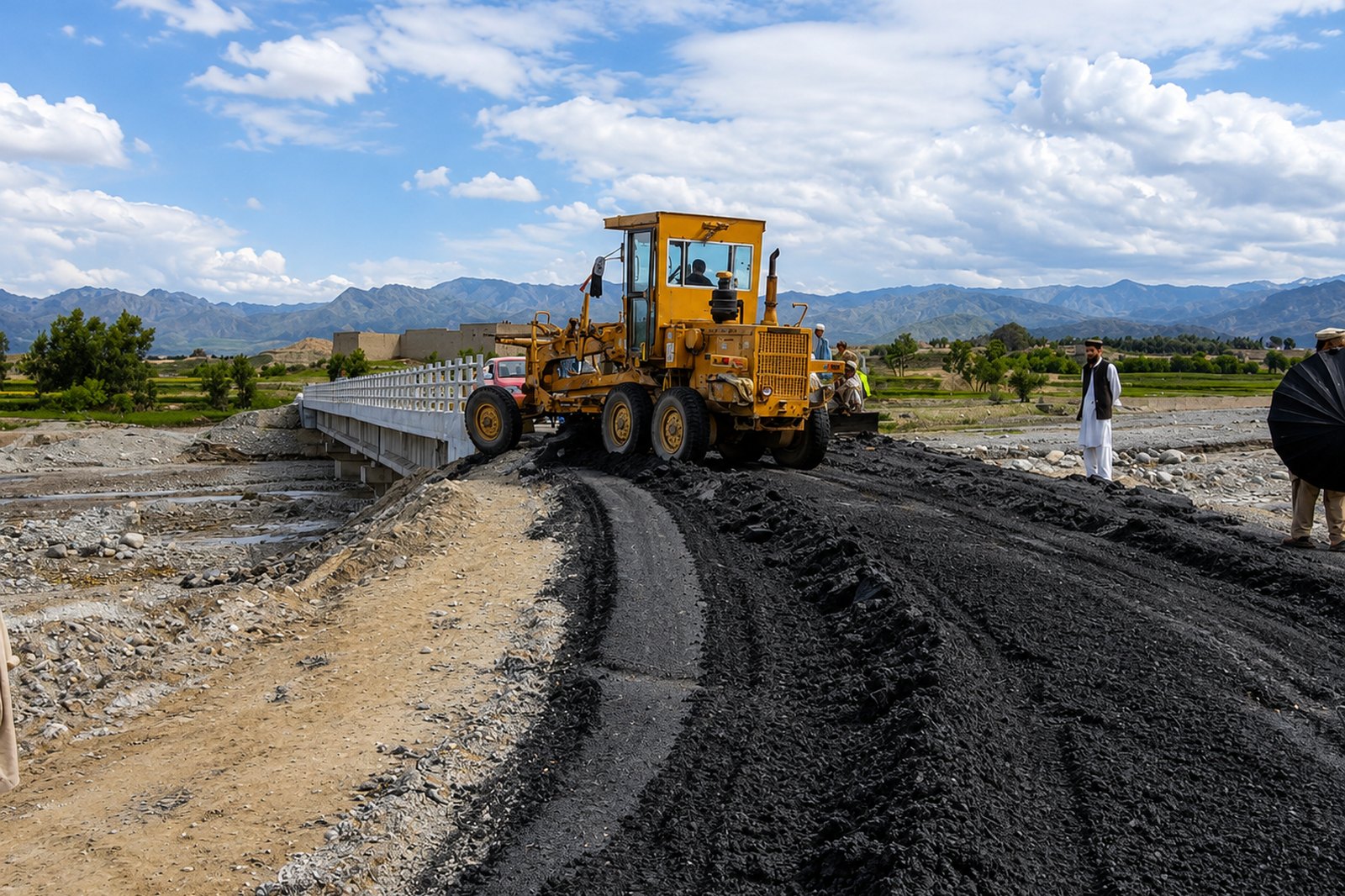
The scope specified double bituminous surface treatment. Given the terrain and the population density along the alignment, DBST would not have lasted. We proposed full asphalt pavement instead, and built it.
Dawlat Shah bridge
The client's design called for 25 MPa concrete. We rechecked the load and traffic flow across the structure and moved the mix to 30 MPa for durability under real service conditions.
Earthen drain protection
Scope required riprap — dry stone masonry. We used concrete mortar to produce grouted masonry instead, at our own expense, for the safety and service life of the road.
Alignment and survey
A poor alignment raises construction cost, maintenance cost and machine operating cost for the life of the road, and once built it is very hard to correct. Our survey teams select routes against four tests: short, easy to build and drive, safe through slopes and cuttings, and economical across the whole life of the asset. At Dawlat Shah in Laghman our engineers set an entirely new alignment, made possible because the community gave up private land and cropland for it.
Environmental assessment
Our environmental engineers run dispersion modelling for vehicle exhaust and plant stack emissions, and assess impact on water, habitat, flora and fauna, agricultural capacity, noise, traffic and landscape before work begins. Where impact is unavoidable we design the mitigation rather than absorb the damage. At bridges 9 and 10 on the Gardez–Khost road that meant diverting the water stream and installing a cofferdam, protecting the irrigation system serving croplands downstream while the structures went in.
Independent verification
In May 2010 the United States Army Corps of Engineers wrote to MECC regarding the 23 kilometre Alishang asphalt road in Laghman. Their engineers recorded that all aspects of the project exceeded design standards, that drainage structures were well designed and constructed with superior materials and workmanship, that MECC supplied laboratory test results for all materials, and recommended MECC for future reconstruction projects in Afghanistan.
US Army Corps of Engineers · Laghman Provincial Reconstruction Team · 18 May 2010
Work is delivered to AASHTO and ASTM standards under a documented quality management system, with sampling, material testing and geotechnical investigation carried out by our own laboratory staff on site.